


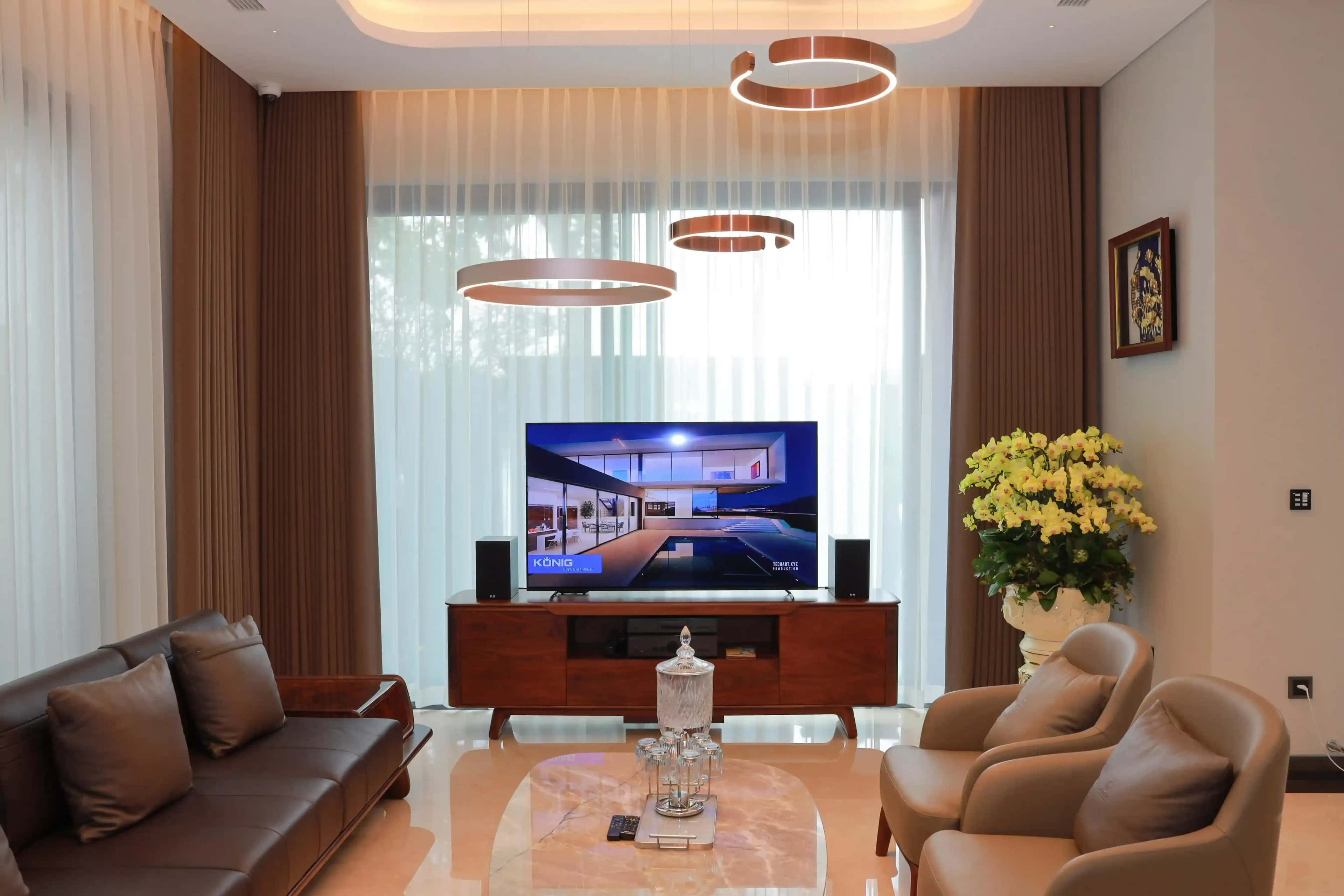
Living Room Interior Design Cost in Delhi NCR: ₹1–3 Lakh Budget Guide
False ceiling, TV unit & flooring costs explained. Serving Delhi, Noida, Gurgaon & NCR. Free estimate in 24 hours, no obligation.
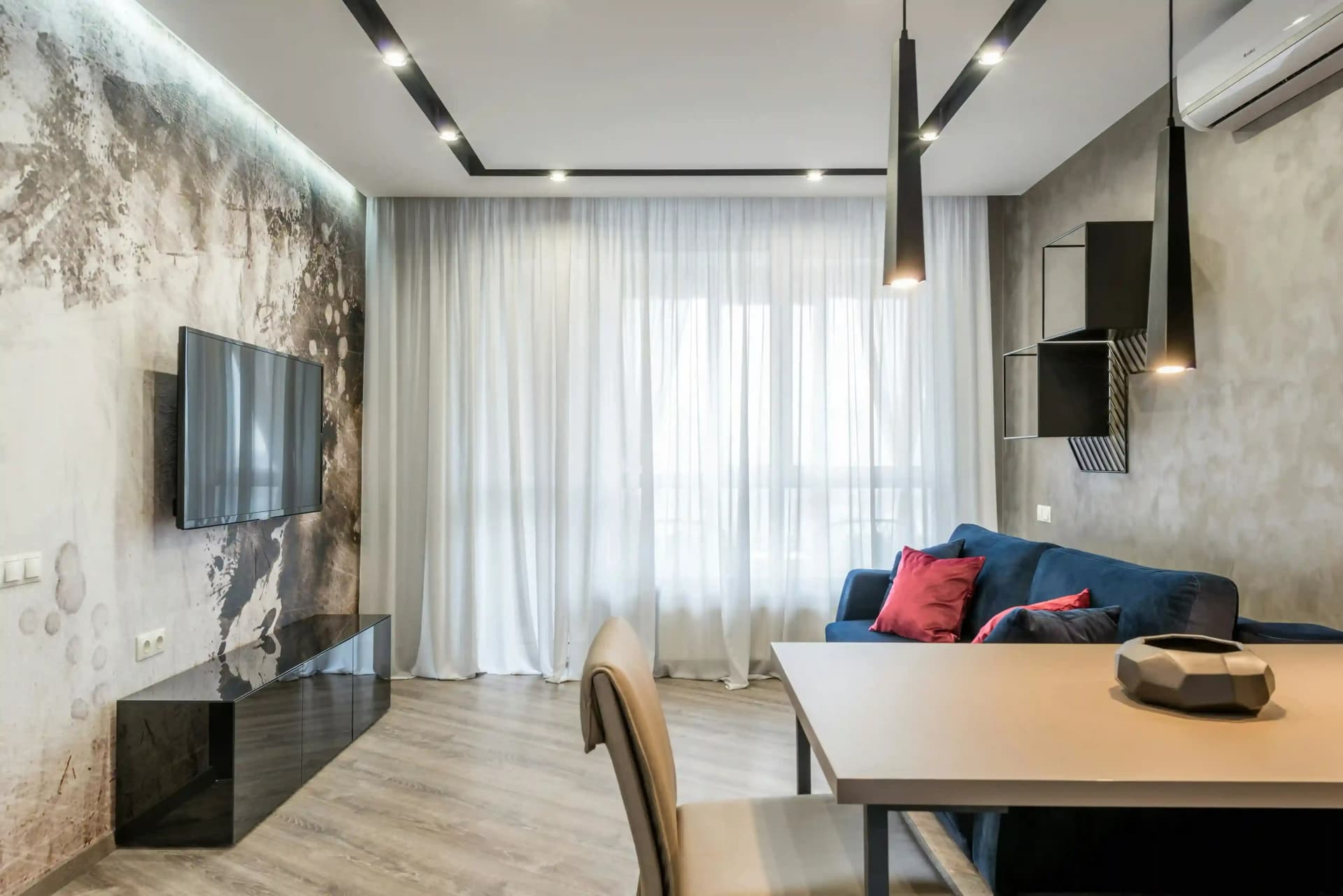
What Does Living Room Interior Design Cost in Delhi NCR?
Real pricing across budget, mid-range & premium—broken down by material, scope & timeline.
PRICING
₹1,200–₹2,500 per sq ft
BHK
1BHK · 2BHK · 3BHK · Villa
SIZE
150–400 sq ft
PROPERTY TYPE
Apartment · Builder Floor · Independent House
SCOPE
False Ceiling · TV Unit · Flooring · Full Design
About The Home
A typical living room interior design in Delhi NCR—meaning false ceiling, TV unit wall, flooring, wall paint, and finishing—costs between ₹1 lakh and ₹3 lakh for a 150–300 sq ft space. The price depends almost entirely on three choices: false ceiling type, flooring material, and TV unit design. A gypsum board false ceiling with simple cove curing runs ₹25,000–40,000; step up to a decorative or coffered design and you're at ₹60,000–1,20,000. Flooring switches from basic vitrified tiles (₹60–100/sq ft) to Italian marble or porcelain (₹250–600/sq ft)—that alone can shift your budget by ₹40,000–80,000 for a 200 sq ft room. The TV unit wall, if done with carpenter-made MDF and Hettich hinges, costs ₹50,000–80,000; modular branded options from Godrej or Sleek jump to ₹1,20,000–2 lakh. Most families in Noida, Gurgaon, and central Delhi choose mid-range finishes—a gypsum false ceiling with ambient lighting, local vitrified flooring, and a well-designed carpenter-built TV unit—which lands around ₹1.5–2.2 lakh all-in.
Here's what actually happens in a real living room project. A couple we worked with in Delhi had a ₹2 lakh budget—they wanted both a feature false ceiling and a proper TV storage wall, plus new flooring. In Week 1, they initially chose Italian marble (which they loved), but that alone was ₹80,000. We pivoted to large-format porcelain tiles that look almost identical at ₹120/sq ft instead of ₹400/sq ft—saved them ₹60,000. They went with a gypsum false ceiling (₹35,000) with recessed LED cove lighting (₹12,000), a carpenter-built TV unit with PU-finish MDF doors and open shelving (₹65,000), and paint (₹15,000). Total: ₹1,87,000. The project ran 50 days because the builder's NOC took an extra week. But here's what surprised them—the hidden costs that no one mentions: site protection (₹8,000), electrical rewiring to hide cables (₹10,000), cleanup and disposal (₹6,000). Without that 12% buffer, they'd have been short. And that's typical—most homeowners underestimate site-level expenses. A similar project in Bangalore would run 15% cheaper; in Mumbai, 15% more expensive.
Why 400+ Delhi & NCR Families Chose Velmore for Living Room Design
The Velmore process is built to remove the stress most homeowners feel. You call on Monday; by Wednesday, a senior designer visits your home, understands your living room, takes photos, measures everything, and listens to what you actually want—not what they want to sell you. By Friday, you get a detailed proposal with itemized costs for false ceiling (gypsum type, lighting spec, labor), flooring (material choice, thickness, installation), TV unit (design, material, hardware brand), paint, and contingency. Nothing is hidden. If the quote is ₹2.1 lakh and they later find electrical work needs rewiring (which happens in 30% of older Delhi apartments), you're told immediately—not at the end. Payment is structured as 30% upfront, 30% at day 25 when materials arrive and prep work is done, 40% on final handover. Most living room projects finish in 45–55 days because Velmore assigns a single site supervisor who coordinates with your builder, electrician, and carpenter—no waiting for people, no finger-pointing when deadlines slip.
What actually separates Velmore is the transparency around material grades and what you're paying for. Most designers quote ₹2,000/sq ft and you never know if that includes Hettich hinges or cheap alternatives, or whether the false ceiling drywall is Magnum or generic brand. Velmore writes everything down—specifically which brand hardware, which thickness of gypsum, which grade of flooring tile. If you want to upgrade from carpenter-made to Godrej modular (₹1.2 lakh instead of ₹65,000), Velmore shows you the exact difference and lets you decide. If you want to save ₹30,000 by swapping marble for large-format porcelain, it's your call, not a sales pitch. This matters because families often feel trapped after they commit. With Velmore, the contract lists exactly what's included and what costs extra—concealed wiring is included, but if your electrician discovers a live wire in the wall (which happens in 1 out of 5 older homes), that's flagged and quoted separately before work begins. You also get a 30-day revision period after handover—if paint color doesn't match your expectation or a door handle feels loose, we fix it at no cost.
What Does Living Room Interior Design Cost in Delhi NCR?
Living room interior design costs between ₹1.8 lakh and ₹7 lakh in Delhi NCR in 2026, depending on size, materials, and design complexity. A basic 150 sq ft living room with a false ceiling, TV unit, wall paint, and essential finishing typically costs around ₹1.8–2.5 lakh. This includes standard gypsum ceiling work, local vitrified flooring, and a simple carpenter-made TV unit.
A mid-range living room setup, which is the most common choice among families in Noida, Gurgaon, and central Delhi, costs around ₹3–4 lakh. This usually includes a designer false ceiling with cove lighting, a custom-built TV unit with better finishes, upgraded flooring, and a modular seating arrangement or sofa set. This category balances aesthetics and practicality without pushing into luxury pricing.
Premium living room interiors go up to ₹5–7 lakh, especially when using imported materials, designer furniture, high-end lighting systems, and feature walls with veneers, stone, or textured finishes. These setups focus heavily on visual impact, layered lighting, and bespoke furniture design tailored to the space.
What Factors Influence Living Room Interior Design Costs in Delhi NCR?
The biggest factor affecting living room interior design cost isn't usually the room size—it's the specification level. Two living rooms of identical dimensions can differ by ₹2–3 lakh simply because of material choices and customization requirements. For example, a standard gypsum false ceiling with basic LED profiles costs significantly less than a layered ceiling with recessed lighting, designer fixtures, and smart controls. Similarly, a carpenter-made TV unit using commercial plywood may cost half as much as a modular unit finished in veneer, acrylic, or PU paint.
Furniture selection also plays a major role. A locally sourced sofa set and centre table can fit comfortably within a mid-range budget, while imported furniture or custom-made pieces can quickly push costs into the premium category. Homeowners should also account for hidden cost drivers such as electrical modifications, wall levelling, curtain systems, and decorative lighting. Understanding which elements contribute most to the budget helps prioritize spending on features that improve both functionality and long-term value rather than focusing solely on decorative upgrades.
Your Questions About Living Room Interior Design Cost, Answered
Honest answers from our design team. No jargon, no pressure.
Living Room Interior Design Cost in Delhi NCR
A complete living room interior design in Delhi NCR typically costs between ₹1 lakh and ₹3 lakh, depending on room size, material choices, and whether you include false ceiling, flooring, and a TV unit. Most families in the NCR region spend ₹1,200–2,000 per sq ft for mid-range finishes—which lands a 200 sq ft living room somewhere around ₹2.4–4 lakh all-in. The primary cost drivers are false ceiling type (gypsum vs POP vs wooden), flooring material (vitrified tiles at ₹60–120/sq ft vs imported marble at ₹250–600/sq ft), and TV unit design (carpenter-made MDF unit roughly ₹40,000–80,000 versus branded modular at ₹80,000–2 lakh). Delhi NCR pricing runs about 20% higher than Bangalore or Hyderabad for identical scope, partly due to labor costs and material transport.
What actually drives living room costs up or down comes down to three concrete decisions you'll make in Week 1. First: false ceiling—a simple gypsum board false ceiling with concealed wiring runs ₹25,000–50,000 for an average 200 sq ft room, while a coffered or detailed design shoots this to ₹60,000–1,20,000. Second: flooring—this is where most families underestimate. Staying with local vitrified tiles keeps you at ₹12,000–24,000 for the room; switching to Italian marble or porcelain (which many Delhi families prefer for resale value) jumps the bill to ₹50,000–1,20,000. Third: the TV unit—a carpenter-built wall-mounted unit with storage and Hettich hinges costs ₹40,000–80,000, but a full modular entertainment wall with ambient lighting and cable management hits ₹1,20,000–2 lakh. Together, these three elements—false ceiling, flooring, TV unit—make up roughly 60–70% of a living room's total budget.
Most designers quote living room work using either a per-sq-ft model or a fixed project fee. The per-sq-ft approach (₹1,200–2,500/sq ft depending on material grade and finish quality) works best if you're designing the full apartment—you get one rate, one timeline. A fixed project fee—say, ₹80,000–2,50,000 for just the living room—makes sense if you're only refreshing this one space and want predictability. Some teams charge a design consultation fee upfront (₹15,000–50,000) that gets credited toward materials if you proceed; this is actually transparent and common in Mumbai and Bangalore now, though Delhi NCR contractors sometimes resist it. Honestly, the per-sq-ft model tends to hide surprises—always ask for a detailed breakup of what that rate includes.
The biggest budget mistake most Delhi and Noida homeowners make is forgetting the 12% contingency buffer—site conditions always reveal surprises. You budget ₹2.5 lakh, but uneven walls mean extra false ceiling material, or electrical rewiring costs another ₹30,000. We also see families confused about what's included in designer fees versus what's extra—often they don't realize that hardware (Hettich hinges, Hafele handles, electrical outlets), paint, and site cleanup charges are sometimes billed separately. Another blind spot: families assume modular furniture is always cheaper. It's not—a Sleek or Godrej living room storage unit runs ₹1.2–1.8 lakh, while a good carpenter with MDF and quality hardware might deliver something equivalent for ₹70,000–1 lakh. And that's fair on both sides—modular comes with warranty and precision; carpenter-made offers flexibility and cost control. The issue is most homeowners don't compare apples-to-apples.
After you finalize a quote, here's what the process actually looks like. Week 1: site survey, material selection, finalization of design and budget (this is where most delays happen—families change decisions midway). Week 2–3: procurement of materials and approval from your builder's society if needed. Week 4–6: carpenter work, false ceiling installation, electrical rough-ins, flooring prep. Week 7–8: flooring laid, paint, hardware installation, final wiring and switch fitting. Week 9: final cleanup, handover. In reality, a 200 sq ft living room takes 45–60 days start-to-finish in Delhi NCR. Payment milestones typically run: 30% upfront, 30% at midway, 40% on completion—always insist on this structure. Most designers also include a free revision period (usually 30 days post-handover) for minor adjustments.
Free Tool
Estimate interior design cost for your space instantly
No signup needed. Get a realistic budget estimate in under 60 seconds.
Free Interior Cost Calculator →Related Cost Guides
Design Elegant Living Spaces with Trusted Interior Experts
Whether you are planning a complete home makeover or upgrading a single room, choosing the right interior designer is the most important step. We help homeowners discover reliable interior professionals, understand design costs, and compare multiple options before making a decision, saving you time while ensuring better results for your home.